
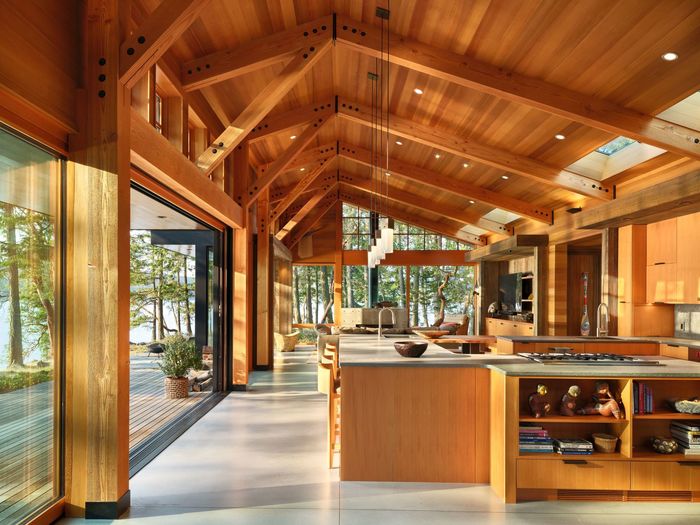
Our San Juan Islands Residence project was recently rewarded the Real Cedar award at the 2025 Canadian Wood Council’s Wood Design & Building Awards. As a follow up to that award and in preparation for publishing the project in the Cedar Book 18, we were interviewed by the book’s lead writer. Sarah Rowland’s questions helped us to consider the importance and implications of using wood in residential architecture and helped to formulate how we might include wood in future projects.
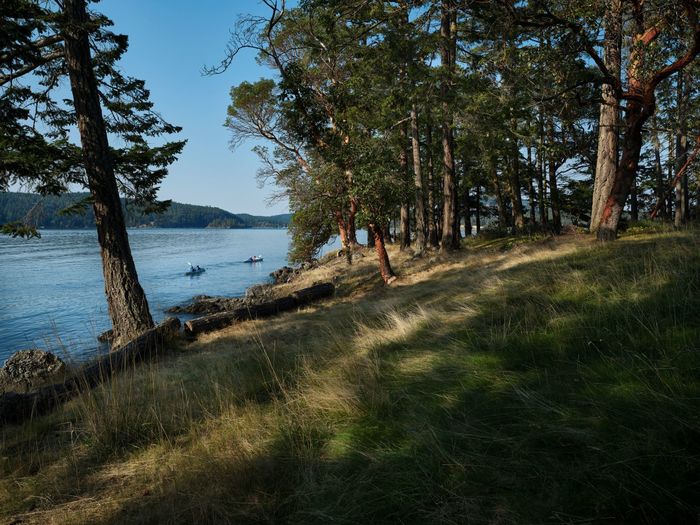
This home is located on a small island in the San Juan Island chain of northwest Washington state in the Salish Sea. Many San Juan Islands are served by the Washington State Ferry system, but this one is only accessible by private boat, or by plane via the small on-island airstrip located in the middle of the island. These islands typically have rocky shores and forested interiors, although much of the interior of the larger islands had been logged and cleared for farming in the past. The small island where this house is located has a nature preserve at its core protecting much of the forest.
If there were no images to go by, how would you personally describe this project to a friend (who’s not an architect)?
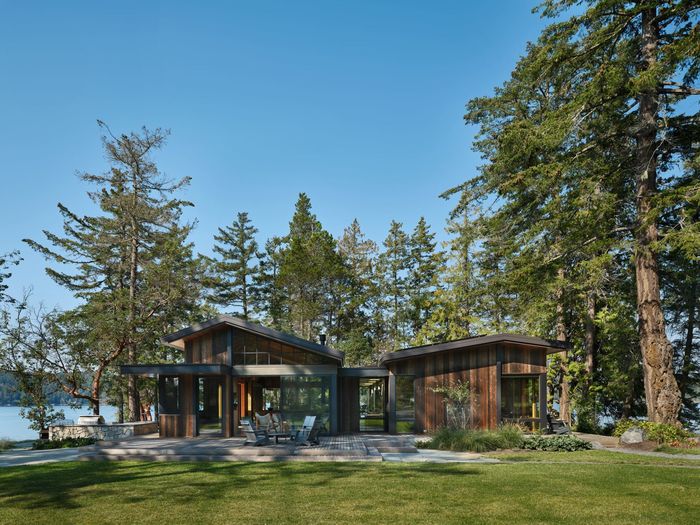
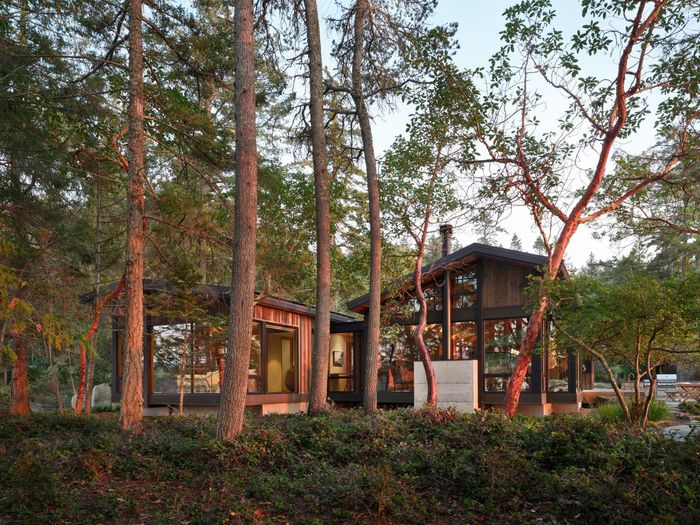
This house occupies an incredible site – a rocky peninsula jutting into the bay, with stands of fir and madrone. A previous home on the site was found to have an inadequate foundation and so was removed. The complex and protective land-use codes of San Juan County allowed the new house to occupy the location of the existing house. The design was meant to maximize views, which are to be had in all directions while creating a house that fits into landscape such that it might be hard to discern when passing by boat. The house is separated into two wings, a living pavilion, open to the expansive western view, and a bedroom wing viewing into a protected cove. There are three bedrooms in 2,900 square feet. The two wings are then expressed by opposing offset gables of different pitch and separated by a flat roof gallery space. The materials are natural, rustic and meant to fit in the landscape. Gridded windows, natural cedar finishes and a rhythmic heavy timber structural system are meant to acknowledge the vernacular and indigenous architecture of the various inhabitants of these islands through time.
What kind of clients were they and what were their needs and specific requests, and how did you deliver on those requests and address those challenges?
The client was looking for an efficient home that was “breathtakingly appropriate” (as they put it) to it’s special site. They wanted to have little barrier between the inside and outside and maximize all views. But they also wanted it to nestle into the environment. It was also their desire to honor the vernacular and indigenous ways of building in these islands. It is our approach, as custom home architects, to reflect the vision of the owner (these just mentioned and more practical needs), respond to the specifics of the site (view orientation, solar orientation, other uses, connections etc.) and to do so with respect for the environment and its resources. Through this process we hope each home becomes a unique creation. Even though they had ideas in mind at the start, these clients were willing to explore design concepts derived through this process finally ending up with a design that none of us could have foreseen. From the roof shape, to the large glass expanses, to the large sliding doors connected inside and out, to the timber frame structure, to the interior and exterior materials including the use of cedar the design came from pursuing this interaction of client and site.
What, if any, were the environmental goals/concerns/challenges going into this project and how did you address those goals?
Environmental goals are integrated into our design process. For this project, protecting, restoring, and enhancing the site was key. Efficient mechanical systems include rooftop solar panels, radiant floor heating, cooling through natural ventilation.
What has turned out to be the most attention grabbing, talked about aspect of this design?
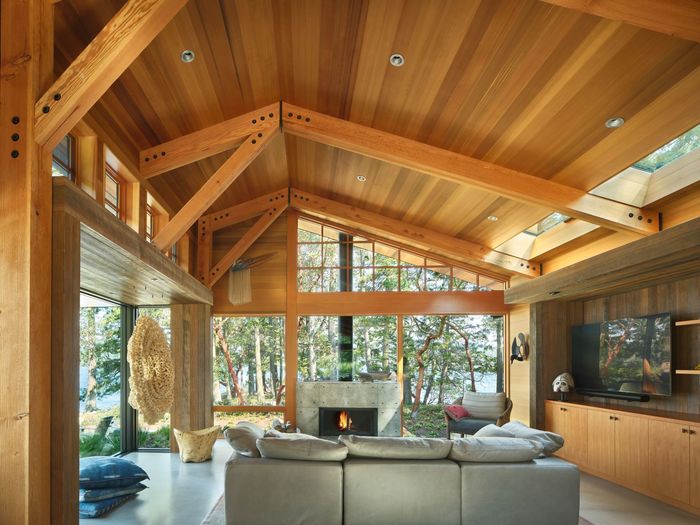
The use of wood throughout the house to define space (sho-sugi-ban niches), create excitement (heavy timber fir frame system) and welcoming warmth (cedar paneling). The exterior of the house and how it nestles into the site and fades into the landscape.
Why did you choose Western Red Cedar for this particular project?
We needed an exterior cladding that was natural, naturally resistant to the harsh coastal climate, beautiful and fitting with the character of the San Juan Islands. Cedar was all of those. On the interior we wanted a material that was warm, not too visually busy and that would be timeless. Again, cedar was the answer.
What grade of cedar (clear, knotty or combo), and what finish(es) did you use and why?
Clear cedar with finishes that preserve the natural character of the wood both inside and out. The owner really wanted the beauty of wood but with a calm grain pattern that would not be visually obtrusive.
What was the client’s initial reaction to your suggestion of using WRC and what was their reaction to the finished product?
I think we all knew cedar was going to play a prominent role in this house from the start based on tradition, past experience and the goals of the project.
Did you have any biophilic goals with this project and if so, how did you meet them?
Goals we had that align with biophilic criteria:
- Connect with nature through the framing of and exposure to views representing the complete character of the place including the always varying weather patterns.
- Connect with nature through the use of natural ventilation through the opening of doors/ windows and skylights to promote natural cooling.
- Connect with nature through the use of natural finishes including cedar and other woods, and stone.
- Connect with nature through a restorative landscape that includes natural plantings and patterns of development.
- Connect to nature through the expression of a rhythmic structural system similar to those found in nature.
Did you use any mass timber products or engineered wood on this project and if so, how do you think Western Red Cedar complemented those products/applications?
Engineered lumber in the form of wood I-joists, plywood sheathing and LSL studs were used throughout. These engineered woods provided the consistency and tight tolerances required by the craftspeople working on this project to work at the highest level of their craft. This includes having even substrates for the application of the cedar siding and interior cedar paneling.
Written by: Mike Butrim Project Architect
