
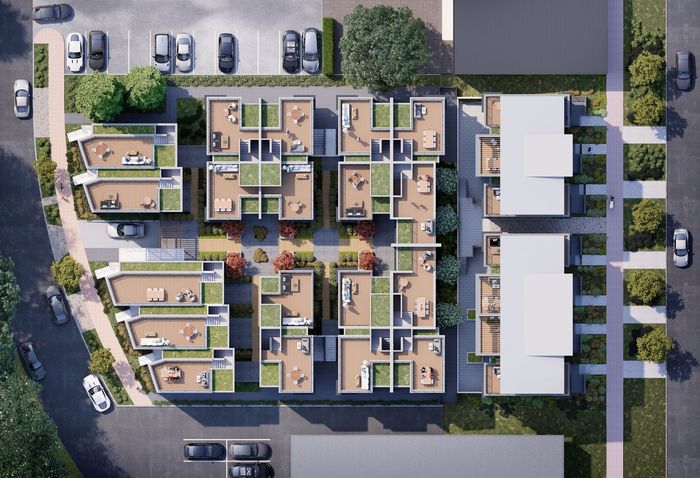
Today we are highlighting an infill site in the Eastlake neighborhood of Seattle. This specific part of Eastlake is unique, a transition zone where Neighborhood Residential, Lowrise, Commercial & Industrial zones intersect along Fariview Avenue East. A community made up of houseboats, townhomes, retail shops, office buildings and shipyards.
Located on the East side of Fairview Avenue, the site was originally home to a 2-story office building designed by Seattle architect Paul Hayden Kirk in the 1960’s. It sits directly adjacent to what was Kirk’s architectural practice, now the home of Vandervort Architects. It features prominent views looking West over the houseboats to lake union, downtown, the Aurora bridge and gasworks park.
The site is a through-lot with frontages on both Fairview Avenue East and Minor Avenue East. It is split zoned, containing both LR-2 and LR-3 portions with the higher density LR-3 portion located on the East half of the site. Due to its proximity to Lake Union the West half of the site is in a shoreline overlay, which has additional standards for development such as a reduced height limit. The West two-thirds of the site slopes up gently as you move away from the water. However, as you approach Minor Avenue East you encounter more significant grading that results in roughly seven feet of grade between the Fairview and Minor frontages.
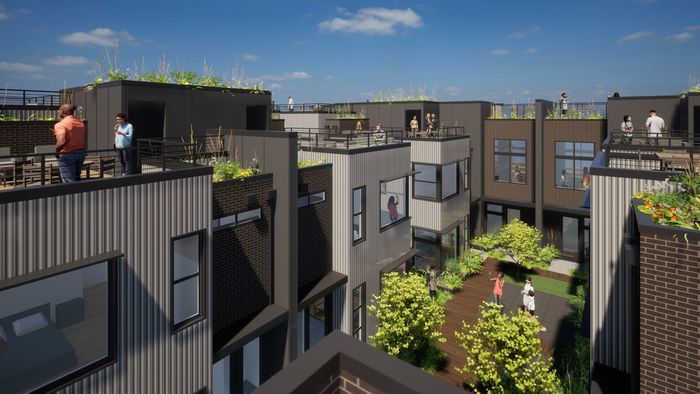
It was determined that it made the most sense to divide the site into (3) parcels. This allowed for a variety of building types to respond to the varying site conditions encountered across the site. On the West side of the site, a three-story, 19-unit townhome project located in the shoreline overlay sits on the gentle slope and fronts on Fairview Avenue East. The sites fronting on Minor Ave E are outside the shoreline overlay area. These sites are divided into (two) four-story Rowhouse developments which combine for a total of seven dwelling units. Basements of these units address the grading challenges associated with the portion of the site fronting on Minor Avenue East.
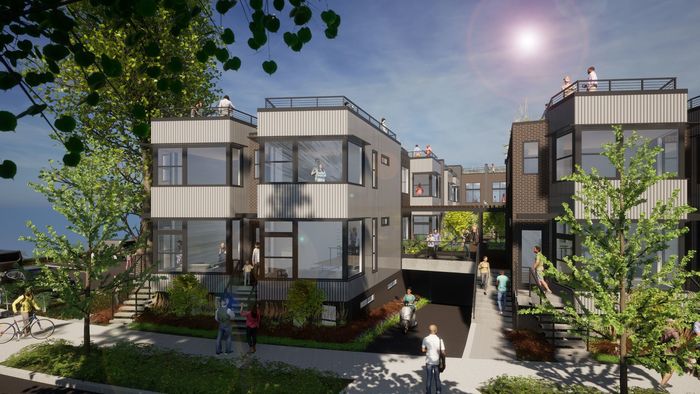
The lake-facing townhouse development was planned around a central communal courtyard. The elevated courtyard serves as the roof of a partially underground common parking garage. It is well-landscaped and helps to establish a central focus for the dwelling units, which are arranged around its perimeter. Often times, on-site parking is developed as a paved parking court. While this is an efficient solution for auto access, it leaves the middle of a site devoid of greenspace. The elevated courtyard helps solve this problem by making the parking less visible and by allowing direct pedestrian access to most of the townhomes.
Units are grouped in a series of five buildings around the central courtyard. We organized the townhomes in groups of separate buildings in order to lower the perceived scale of the development while providing views through the site. This design decision increases open space and access to natural light. Perimeter units are all 3-stories and relate to the adjacent grade. The five street-fronting units are unique in that they have partially buried basements. This provided a lowered building scale against the street while elevating the main level above the street. This increased privacy / security also provides better views of the lake and direct back-access to the common garage and the common courtyard. The remaining 2-story units sit atop the garage roof and take access directly from the central courtyard. In addition to the access to the central courtyard, each unit has private outdoor space in the form of rooftop decks. By accessing these decks via internal stairs instead of penthouses we eliminate obstructions and open the view up for all the units.
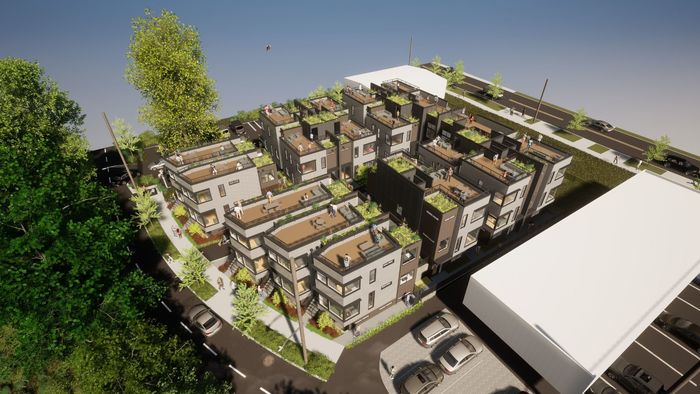
At four stories with daylit basements, the Rowhouses are more closely related to the apartments and office buildings in their immediate surroundings along Minor Avenue East. To help mitigate the change in scales between the Minor and Fairview side we decided it made the most sense to break the Minor frontage into two sites. This created a natural slot between the two buildings that helps reduce the scale while providing increased access to light and view through the site for pedestrians and neighboring buildings.
Grade changes on the East of the site as we approached Minor Avenue East were dealt with by creating daylit basements for each unit. This vertical change creates an Entry level above that is a full story above the entries at the townhomes. This allows the third and fourth levels to be above the roofs of the Fairview Townhomes and capture the view to the West that otherwise would have been blocked.
Vandervort Architects believes in careful attention to site-specific design responses, whether the site is rural, suburban or urban. While all these dwellings share the same design language, the Townhomes and Rowhouses respond to a different set of circumstances. This can be seen in changes in scale, the way they address the ground, and their relationship to the streets they front on. Architecture is a response to its environment, its place and as such the design of this project is a response to this specific site and surroundings. Be it in the selection of materials such as brick which responds to neighboring housing and office buildings to the corrugated metal which ties to the maritime activity in the area the project is a response to its environment.
Written by: Brian O'Connor Project Manager
